The global rate cycle that began in 2022 reached Southeast Asia through different transmission channels and at different velocities depending on each market’s monetary policy architecture. The result is that first-home buyers in Malaysia, the Philippines, Indonesia, and Singapore experienced meaningfully different affordability conditions during the same macroeconomic period — a distinction that matters considerably for understanding where affordability stress concentrated and where structural adjustment is still working through the system.
The common element was a global rate environment that pushed benchmark rates sharply higher across a compressed timeframe. The divergence was in how each central bank responded and how directly that response translated into the mortgage cost that a first-time buyer encountered at the point of financing a property purchase.
Malaysia: The Most Direct Transmission
Malaysia’s monetary policy transmission into mortgage markets is direct and mechanical. The Overnight Policy Rate set by Bank Negara Malaysia is the benchmark off which commercial bank standard base rates are priced. When OPR moves, standard base rates move by exactly the same amount, and floating-rate home loans reprice accordingly.
Between May 2022 and May 2023, Bank Negara Malaysia raised the OPR in five successive increments: from the pandemic-era floor of 1.75 percent to 2.0 percent in May 2022, then 2.25 percent in July, 2.50 percent in September, and 2.75 percent in November of the same year, before a final increase to 3.0 percent in May 2023. The OPR has been held at 3.0 percent since. The cumulative increase was 125 basis points over a twelve-month period, which fully passed through to the floating-rate home loans that represent the dominant mortgage structure in the Malaysian market.
For a Malaysian first-home buyer who had structured a RM 500,000 home loan on a 30-year tenure at the beginning of 2022, the interest rate on that loan rose by the full 125 basis points over the following year. Monthly repayments on such a loan increased by approximately RM 300 to 400 per month depending on the precise loan terms and bank pricing. For a household with a gross monthly income in the RM 7,000 to 8,000 range, which covers buyers accessing Malaysia’s affordable housing segments, this was not a marginal adjustment. It was a meaningful compression of discretionary income and a material deterioration in the effective affordability ratio for buyers who were already stretched.
The Bank Negara Malaysia OPR at 3.0 percent remains below the pre-pandemic rate of the same level that the market experienced from 2018 to 2020, so the current environment is not historically abnormal. The speed of the adjustment, concentrated within twelve months rather than distributed across a multi-year cycle, produced affordability stress in the segment of the market least able to absorb it: first-time buyers without existing equity, often purchasing in the RM 300,000 to 500,000 range where the affordability margins are thinnest.
Philippines: Aggressive Tightening, Compressed Affordability
The Bangko Sentral ng Pilipinas executed one of the more aggressive rate cycles in Southeast Asia during this period. The BSP raised the policy rate thirteen times between May 2022 and October 2023, with cumulative increases reaching 450 basis points and the rate peaking at 6.5 percent in the first half of 2024. The primary driver was a domestic inflation episode that required a more forceful monetary response than some of the region’s lower-inflation economies, as recorded in the BSP’s published key rates data.
The Philippine residential market experienced real price appreciation of 3.93 percent in 2022 in nominal terms, which translated into a real decline when adjusted for the inflation running at that time. In 2023, nominal price growth in the central business district segments ran at approximately 3.98 percent, essentially flat in real terms. For first-home buyers, the combination of higher nominal property prices and sharply higher mortgage rates compressed affordability from both directions simultaneously.
The Philippine market has a structural affordability challenge that predates the recent rate cycle. Housing supply in Metro Manila and the major provincial growth centres has not kept pace with urbanisation-driven demand, and the affordable housing segment is chronically undersupplied. The rate rises of 2022 to 2023 layered a financing cost shock onto a market that was already running with constrained affordability ratios for middle-income households. Buyers eligible for the Pag-IBIG Fund housing loan programme, which offers fixed-rate mortgages for qualified borrowers at subsidised rates, were somewhat insulated from the commercial bank rate environment, though this protection is available only within the programme’s income and loan amount limits.
Indonesia: A Delayed But Significant Adjustment
Indonesia’s Bank Indonesia followed a tighter-than-regional rate path that extended into 2024. From a pandemic-era low of 3.5 percent in July 2022, the BI Rate reached 6.25 percent by August 2024, an increase of 275 basis points over a two-year period. The Indonesian mortgage market, which operates primarily on floating-rate structures linked to bank lending rates, absorbed this increase across a longer adjustment window than Malaysia’s near-immediate OPR pass-through.
The Indonesian property market’s affordability dynamics are complicated by the formal and informal segmentation of the housing market, the geographic dispersion of economic activity, and the income distribution profile of the first-time buyer cohort. In Jakarta and the major secondary cities where formal property markets are active, the rate environment has compressed affordability for the formal middle-income buyer segment. In lower-income and peri-urban segments, access to formal mortgage financing was already the binding constraint before the rate cycle, and the rate environment is a secondary consideration relative to the structural financing access challenge.
Singapore: A Different Architecture
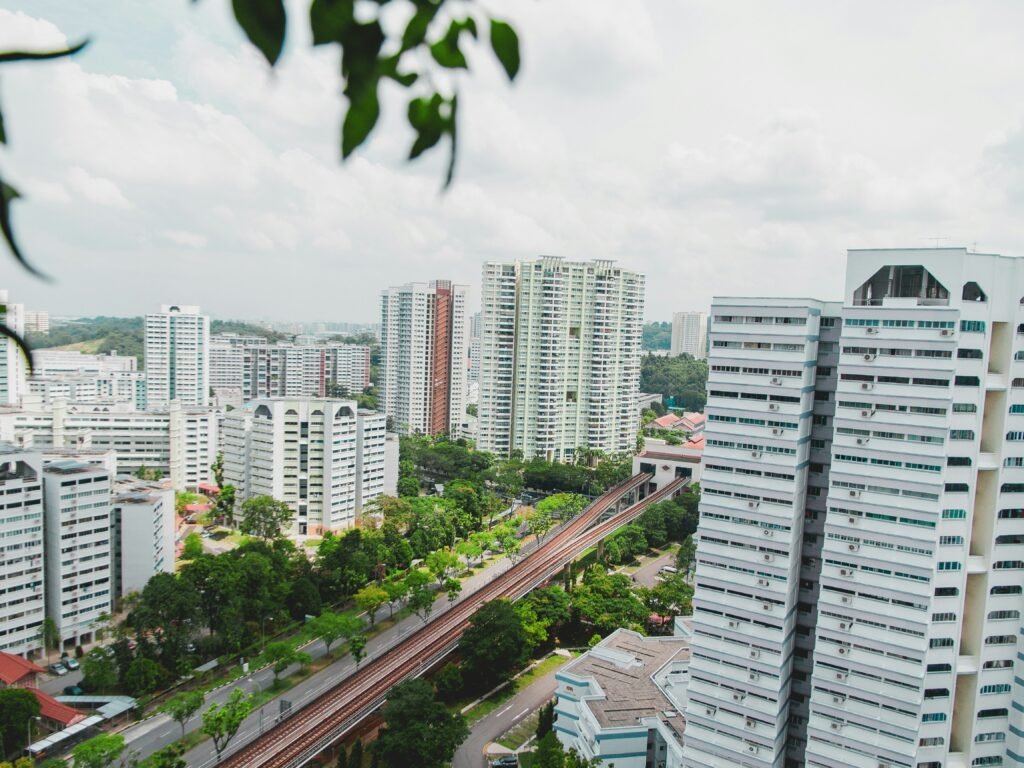
Singapore occupies a structurally distinct position in this comparison because the Monetary Authority of Singapore does not manage monetary policy through a policy interest rate. MAS operates through the exchange rate mechanism, managing the Singapore dollar’s trade-weighted nominal effective exchange rate within a policy band, rather than setting a benchmark rate that banks price mortgages against.
This architecture means that Singapore’s domestic mortgage rates do not respond mechanically to a local central bank rate decision. Instead, Singapore mortgage rates are benchmarked off the Singapore Overnight Rate Average, which follows global short-term rates and was pulled upward by the US Federal Reserve’s rate cycle through market transmission rather than direct MAS action. SORA-linked floating rate mortgages in Singapore rose substantially from 2022 to 2023 as global rates repriced.
The MAS deployed macro-prudential instruments through its September 2022 measures to promote sustainable property market conditions, which included the TDSR tightening from 60 percent to 55 percent and a 0.5 percentage point increase in the medium-term interest rate floor applied in TDSR computations, bringing the floor to 4.0 percent per annum. This floor does not represent the actual mortgage rate but is used in stress-testing borrower capacity. At a 4.0 percent floor, a household’s serviceability is assessed against a rate higher than the then-prevailing market rate , a conservative underwriting adjustment designed to ensure that borrowers could absorb further rate increases without breach of the TDSR threshold.
The practical consequence for Singapore first-home buyers was twofold: the direct mortgage rate environment became more expensive through SORA-linked rate repricing, and the TDSR adjustment reduced the maximum loan quantum available at any given income level. For HDB buyers using the BTO pathway, the dominant route for Singapore citizen first-home buyers, the TDSR and Mortgage Servicing Ratio framework governs the financing structure, and the September 2022 adjustments directly affected the loan-to-income ratios available to this cohort. As covered in the analysis of the BTO application as a financial architecture decision, the interaction between TDSR, CPF OA usage, and loan tenure choices is the primary modelling exercise that most buyers in this system underinvest in.
What the Cross-Regional Data Tells Us
The common signal across these markets is that the 2022 to 2023 rate environment was a material affordability headwind for first-time buyers without established equity. The severity varied: Malaysia felt it immediately through full OPR pass-through, the Philippines absorbed a larger absolute rate increase over a longer period, Indonesia experienced a delayed but substantial repricing, and Singapore experienced it through the combination of SORA rate movement and macro-prudential tightening.
What this period also revealed is that the design of monetary transmission matters for housing market outcomes as much as the rate level itself. Singapore’s exchange-rate-based monetary policy framework meant that MAS could calibrate the property market impact through targeted macro-prudential tools rather than through the blunt instrument of a rate decision that would simultaneously affect all credit-using sectors of the economy. For the region’s other markets, the central bank rate and the mortgage rate are more directly coupled, which produces faster affordability adjustment in both directions — downward when rates ease, and upward when they tighten.
The medium-term outlook for SEA first-home affordability depends considerably on whether this rate cycle has peaked and begun to reverse, and at what pace. The interaction between rate levels and the structural supply constraints in most SEA markets means that even a meaningful rate reduction will not rapidly restore affordability ratios to their pre-2022 levels, because supply pipelines have not expanded commensurately with the urbanisation-driven demand that has continued to accumulate through the rate cycle. The affordability deterioration of 2022 to 2024 will take more than a rate normalisation cycle to fully reverse, in markets where supply-side constraints are the binding limit rather than the financing cost. The wider forces shaping this dynamic are covered in our analysis of how Fed rate decisions transmit differently across SEA capital markets and the structural divergence between markets with institutional property financing infrastructure and those still building it.