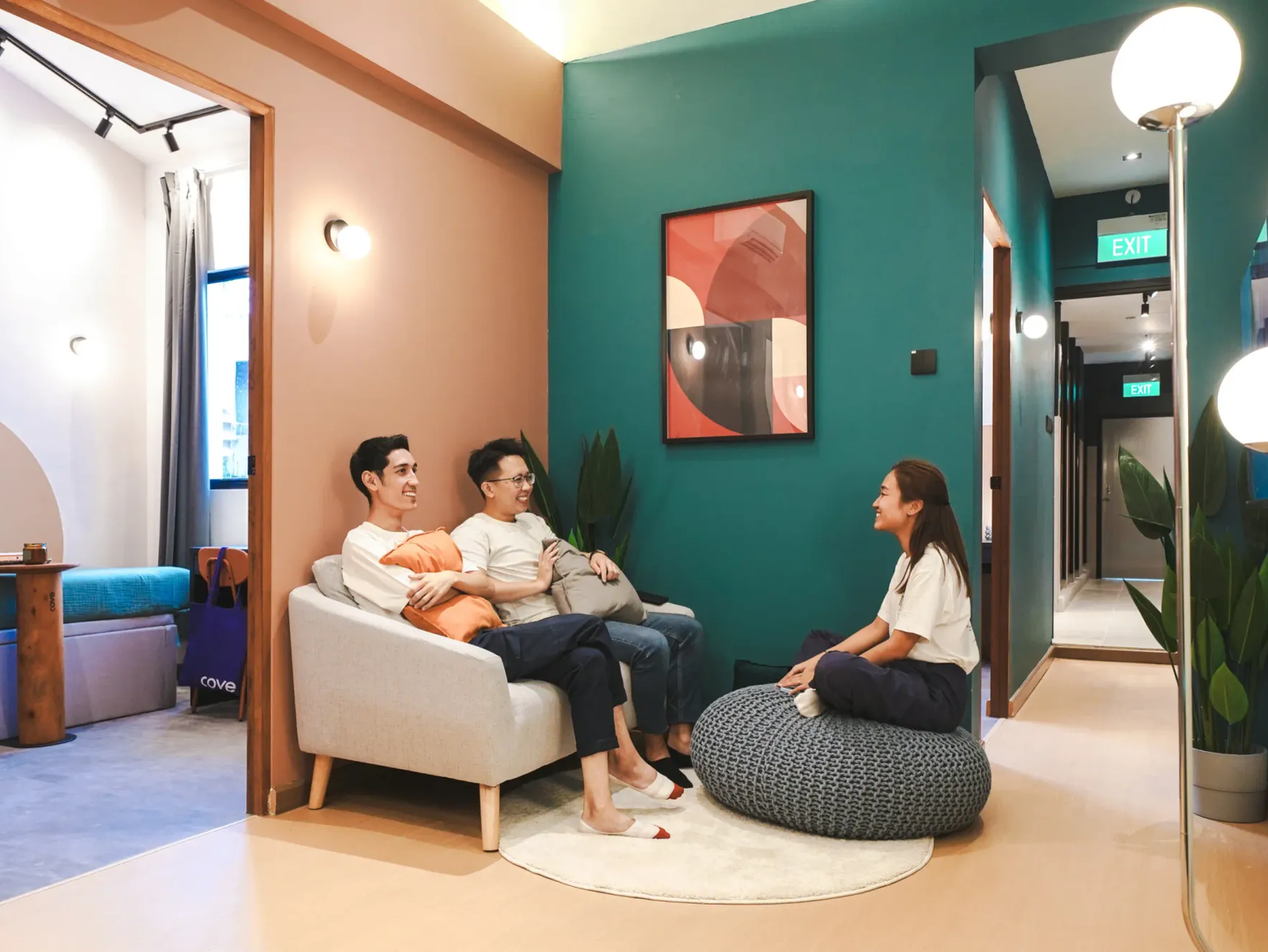
Two things are simultaneously true about co-living in Southeast Asia. CapitaLand Ascott established CLARA II, a USD 600 million co-living fund, in early 2025, targeting gateway cities across Asia Pacific with a mandate explicitly oriented toward the institutional co-living opportunity. Singapore’s co-living sector attracted over SGD 1.4 billion in transactions as the market matured toward institutional scale, according to JLL’s 2025 Singapore real estate market analysis. The demand thesis has real demographic support: young professionals, digital nomads, regional executives on project assignments, and students requiring furnished urban housing with flexible tenures. And at the same time, Hmlet, the region’s most visible co-living operator, merged with European player Habyt in 2022 under the pressure of unit economics that did not scale as cleanly as the pitch decks implied. The global market added more than 11,500 co-living beds in 2024, a 21 percent increase, though Asia-Pacific, which accounts for roughly 40 percent of the global market, is growing at a more measured 8 percent compound annual rate according to market research tracked by CBRE’s Asia Pacific co-living sector analysis.
The honest answer to whether the co-living thesis in SEA is oversold or underbuilt is: it depends entirely on which geography and which buyer cohort you are interrogating. The regional narrative is doing work that only parts of the underlying market can support.
Where the Thesis Actually Holds
The co-living thesis is most demonstrably validated in Singapore, and to a lesser degree in Hong Kong, as a professionally managed alternative to shared serviced apartments and traditional rental housing for young professionals, short-assignment expatriates, and relocated regional employees. The demand characteristics are a function of Singapore’s structural conditions: high residential property costs, a transient expatriate population that does not want the friction of a standard tenancy agreement, a digital nomad cohort that expanded materially post-pandemic, and an institutional real estate market sophisticated enough to price co-living as a distinct hospitality-adjacent asset class.
The SGD 1.4 billion in Singapore co-living transactions recorded by 2025 is institutional capital making a market position in an asset class it can underwrite, manage, and potentially securitise. CapitaLand’s CLARA II fund mandate for “gateway cities in developed markets across Asia Pacific” is telling: the institutional capital is targeting the developed, high-cost, high-liquidity end of the spectrum, not the emerging market development story.
The student housing sub-segment within co-living deserves separate treatment and has historically been the underappreciated segment in the broader co-living conversation. Cities such as Singapore, Kuala Lumpur, and Manila have structural undersupply of quality purpose-built student accommodation that operates more predictably than the digital nomad or flexible professional segments. Occupancy in student accommodation tends to be demand-driven by enrollment cycles rather than economic sentiment cycles, which makes the cash flow characteristics more institutional in quality. This segment has attracted less narrative attention than the lifestyle-oriented co-living product but is arguably the more investable long-term proposition across a wider range of SEA markets.
Where the Thesis Has Been Overstated
The co-living thesis becomes less supportable when projected uniformly across markets that lack Singapore’s cost structure, liquidity, and institutional real estate infrastructure. In Vietnam, Indonesia, Thailand, and the Philippines, the conditions that underpin the Singapore co-living model are partially or wholly absent. Residential property costs in these markets, while rising, have not reached the level where co-living is a rational economic substitute for conventional rental housing at the price points that institutional operators need to charge to generate returns.
Hmlet’s 2022 merger with Habyt was not a strategic expansion move. It was a market rationalisation event, and the structure reflected the unit economics of a co-living operator that had expanded faster than its ability to fill rooms at the yields required to service its occupancy-linked rent obligations. The lesson from that consolidation is that co-living in SEA has a viable institutional market in high-cost gateway cities, but the growth-at-any-cost version of the story, rolling out across multiple markets simultaneously in anticipation of demand catching up with supply, did not survive contact with the market. That the top five global co-living operators now maintain 65 percent market concentration, up marginally from 2023, reflects a market that has consolidated around the operators with the balance sheets and operational discipline to run the product at institutional quality.
In emerging SEA markets outside the gateway cities, co-living is more accurately characterised as an early-stage asset class where supply, regulatory clarity around the hospitality-residential hybrid classification, and institutional exit pathways are all still developing. This is not the same as saying the opportunity is absent. The investment timeline and risk profile are different from a Singapore-style mature institutional trade. The contrast with what capital actually achieves in established industrial real estate across Malaysia and Vietnam is instructive: the returns available in unglamorous logistics and manufacturing facilities, backed by institutional leases and clear title structures, have been more consistent than co-living’s development-stage returns profile in markets outside the gateway cities.
The Investment Question That Matters
The market’s structural question is whether co-living in SEA represents an undersupplied institutional asset class attracting appropriate capital into a long-term demand story, or a lifestyle narrative that has generated early investor enthusiasm faster than the underlying unit economics can support at scale.
The answer is both, depending on the geography and the vintage. Singapore’s institutionalised co-living market is a legitimate addition to the institutional real estate opportunity set, and CLARA II’s USD 600 million mandate suggests that sophisticated capital has reached that conclusion. The broader SEA co-living thesis — the regional narrative that co-living is a structural undersupply across all SEA markets waiting to be filled — is running ahead of the market conditions that would validate it outside of a handful of nodes.
The diverging growth trajectories of SEA economies, covered in our analysis of which markets are capturing structural growth, matter here because co-living demand in any market is a derived demand from that market’s economic activity, expatriate population dynamics, and urban housing cost pressures. Markets with strong structural growth and rising urban housing costs are building the conditions for co-living’s thesis to play out over the medium term. Markets with weaker growth trajectories, lower urban housing costs, or less transparent institutional property frameworks are not. The regional map is not uniform, and the capital allocation decision should not treat it as if it is.