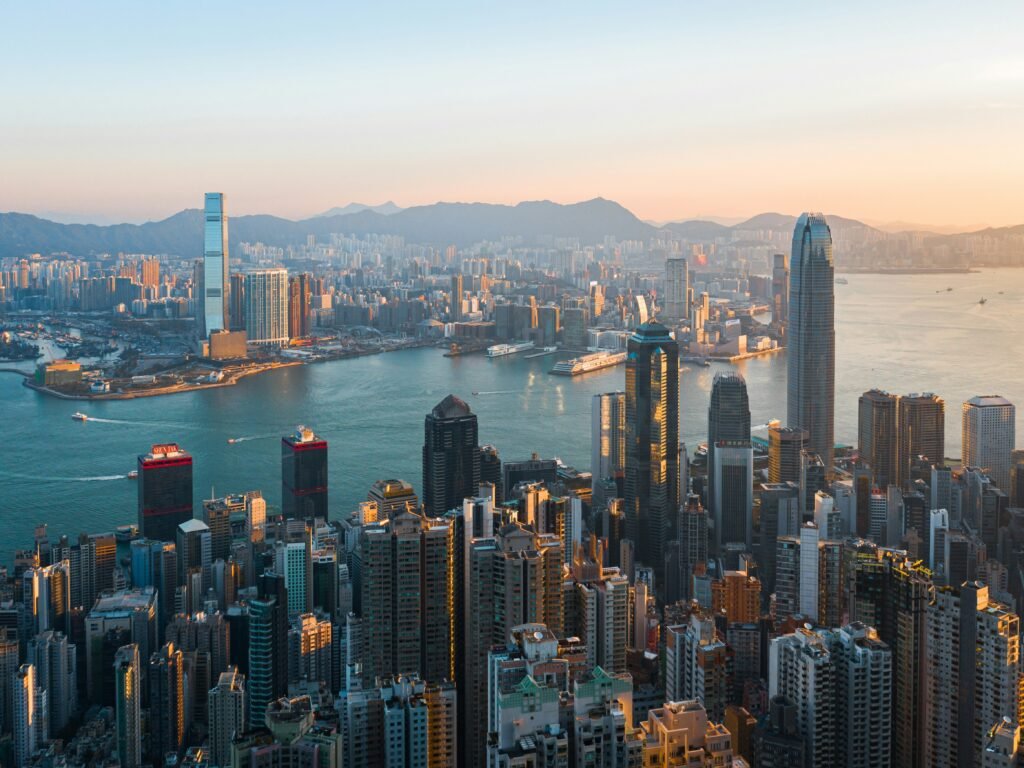
The Hang Seng Index peaked in early 2021 above 31,000. It has spent the years since trading at levels that, adjusted for the intervening period of global equity appreciation, represent a material underperformance relative to every comparable financial centre benchmark. Policymakers in Hong Kong have responded with a series of structural interventions (reopened listing channels, reformed fund rules, deepened integration with Shenzhen), but the index has not sustainably recovered, while Singapore has simultaneously consolidated its position as the preferred destination for international capital seeking Asian exposure from a neutral jurisdiction. The equity funds raised in Hong Kong did surge 322 percent year-on-year in the first eight months of 2025, driven largely by mainland Chinese companies shifting their listings away from the United States. The source of that capital flow is revealing. It represents redirected mainland issuance, not a restoration of international investor confidence in Hong Kong as a neutral capital market.
This distinction matters for how to read the city’s trajectory. A re-rating of Hong Kong from a globally neutral capital market to a principally China-adjacent one is not a cyclical event. It is a structural repositioning with corresponding implications for where international capital chooses to book its Asian exposure.
International Family Office Capital Is Flowing to Singapore, Not Hong Kong
International family office capital has been flowing toward Singapore over Hong Kong for reasons that are structural and predated the most recent Hang Seng weakness, and the direction of that flow is not reversing. Between 2023 and 2030, ultra-high-net-worth and high-net-worth families across Asia Pacific are expected to transfer approximately US$5.8 trillion in intergenerational wealth, according to Citywealth’s analysis of Asia’s wealth shift. The family office count across both Hong Kong and Singapore has roughly quadrupled since 2020. For more on Singapore’s family office ecosystem and how it has been structured to attract this capital, see our dedicated analysis.
Singapore’s appeal to international family offices rests on three durable characteristics: political and institutional neutrality, legal system reliability, and the breadth of its asset management ecosystem. In a geopolitical environment where capital is increasingly sensitive to jurisdiction risk (where the question of whether assets could be frozen, restricted, or politically exposed has become a first-order consideration), Singapore’s profile as a genuinely neutral financial centre has become more valuable, not less. Hong Kong’s integration with the mainland, which was once its principal source of competitive advantage as a gateway to China, has become a source of uncertainty for international capital that needs to remain insulated from Chinese jurisdictional risk.
Singapore’s MAS Tightening Is a Quality Filter, Not a Deterrent
Singapore has not been a passive beneficiary. The Monetary Authority of Singapore tightened the Variable Capital Company framework requirements and raised the minimum investment thresholds for fund structures in 2024, explicitly screening for genuine wealth management activity rather than residency optimisation. Some family offices that arrived during the 2021–2022 wave have not had their structures renewed. This tightening is often reported as a reduction in Singapore’s attractiveness. It is more accurately read as a quality filter that protects the jurisdiction’s institutional credibility, which is the very thing that makes it attractive to the capital that actually matters.
The family office capital that Singapore is actively cultivating is long-duration, professionally managed, and oriented toward genuine wealth preservation and deployment. It is not the round-tripping or residency-motivated capital that the new screening is designed to deter. The distinction is important for understanding what Singapore is building: not the largest family office hub in Asia by count, but the most credible one by institutional standard.
The Hang Seng’s Composition Has Structurally Changed the Investor Base Willing to Hold It
The Hang Seng’s prolonged weakness reflects a structural change in index composition and the investor base willing to hold it, not simply a valuation problem awaiting a valuation correction. The companies that have anchored the index (large Chinese financial institutions, property developers, and technology platforms) have all undergone significant re-ratings that are not solely explained by earnings trajectories. The Evergrande collapse and the broader property sector stress, the technology platform regulatory reset of 2021–2022, and the persistent overhang from US-China capital market friction have collectively shifted the risk premium on Chinese-listed assets in ways that are not easily reversed by policy stimulus alone.
For the institutional investors who previously used Hong Kong-listed equities as their primary vehicle for Chinese exposure, the re-rating has prompted a reconsideration of the exposure itself. Some have reduced China weights in their Asian equity allocations. Others have maintained China weights but shifted the booking of related capital activity (the research infrastructure, the deal sourcing, the advisory relationships) to Singapore, where the institutional environment provides more operational certainty. The result is a migration of financial centre activity that does not always show up in AUM figures but is visible in hiring patterns, office footprint, and the location preferences of fund managers establishing or expanding in Asia.
Hong Kong and Singapore Are Now Serving Different Capital Bases
Hong Kong and Singapore are now serving structurally different capital bases: Hong Kong as the intermediary for China-linked flows, Singapore as the neutral coordination hub for international capital with Asian exposure. This shift is not complete, and Hong Kong retains significant advantages as the access point for mainland Chinese capital markets that Singapore cannot replicate. But the composition of what each city does best is diverging in ways that are structural rather than temporary. For sovereign funds, institutional investors, and family offices whose primary concern is jurisdictional neutrality and institutional predictability, Singapore’s trajectory is a structural capture of a distinct and growing market position — not a competition with Hong Kong. For the broader divergence in how SEA economies are positioning around institutional capital and investment flows, see our regional analysis.
For a related read on how Singapore’s sovereign capital is being deployed across sectors and geographies, see our analysis of Temasek and GIC’s latest portfolio signals.
Sources: