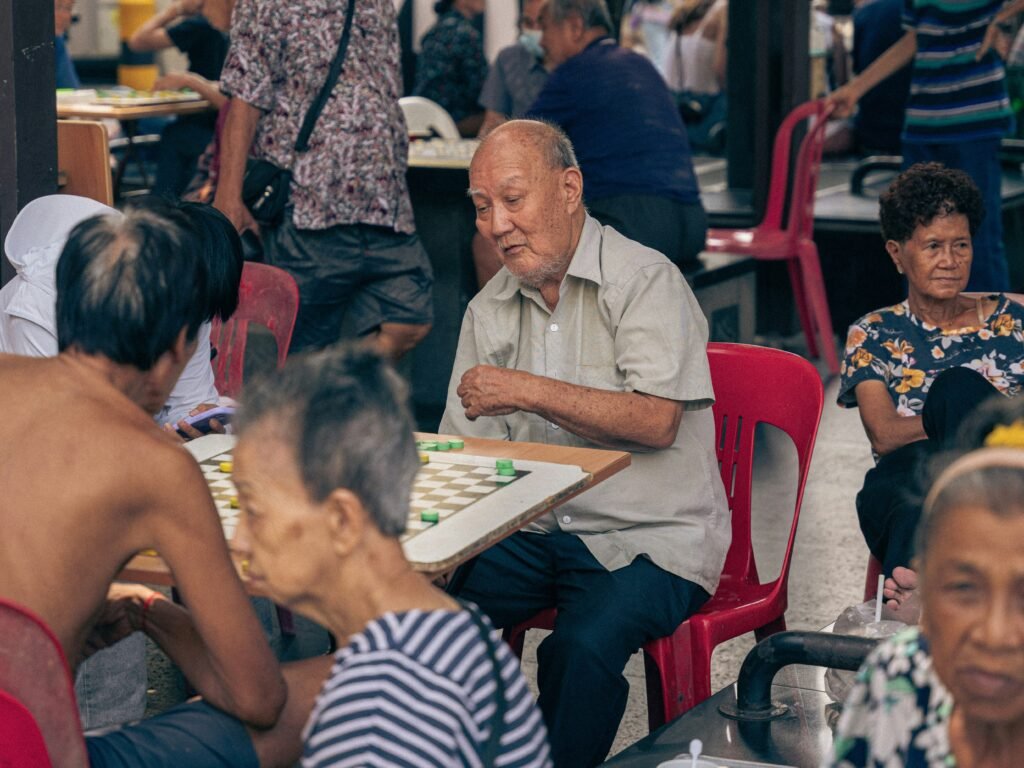
There is a category of investment that delivers measurable returns across health, career longevity, cognitive function, and subjective wellbeing — and that the average Singapore professional in their thirties actively underbuilds. It is not a financial instrument. It is not a supplement stack or a morning routine. It is friendship, and more specifically a strong social network, and the research behind its returns is more rigorous than the evidence base for most of the life optimisation behaviours that actually get attention.
The Harvard Study of Adult Development, the longest longitudinal study of adult life in recorded history, now spanning over eighty years and two generations, found that the quality of close relationships at midlife was the single strongest predictor of physical health and cognitive function at 80. Not genetics, not income, not exercise habits. Relationship quality. The study’s director, Robert Waldinger, has been unambiguous in public presentations about the implications of this finding: loneliness is as damaging to health as smoking fifteen cigarettes a day, and social isolation accelerates cognitive decline in ways that no other modifiable lifestyle factor fully offsets.
The reason this evidence does not change professional behaviour as much as it should is not that people are unaware of it. It is that the structural conditions of professional life in Singapore in your thirties and forties work systematically against the behaviours required to build and maintain strong social networks.
Why Singapore High-Performers Treat Friendship as a Surplus Activity
Singapore professionals who build strong friendships into their forties report significantly higher life satisfaction at equivalent income levels. The ones who don’t typically know the research. The structure of professional life works against the behaviour anyway.
The professional who is genuinely performing at a high level in Singapore, managing a complex role, building a business, raising children, staying fit, and maintaining a relationship, is operating at close to full capacity in terms of discretionary time and attention. The activities that yield obvious, measurable near-term returns get prioritised. The gym session has a direct physical feedback loop. The work project has a deadline and a consequence. Friendship maintenance, which includes the Sunday brunch that requires forward planning, the message to a friend you haven’t spoken to in three months, and the effort of showing up consistently for the people in your life when your schedule is genuinely full, has a diffuse, long-cycle return that doesn’t show up in any dashboard.
The psychological literature on this is clear. A 2021 meta-analysis in PLOS ONE covering 148 studies and over 300,000 participants found that individuals with adequate social relationships had a 50 percent greater likelihood of survival compared to those with poor or insufficient social connections. The hazard ratio for social isolation exceeds that of physical inactivity, obesity, and is comparable to smoking. These are population-level statistics, not philosophical propositions.
The professional in Singapore who is “too busy” to invest in their social network is not making a values-based choice. They are making a modelling error — treating friendship as a consumption item that gets funded from surplus time, rather than as an infrastructure investment that determines the output quality of everything else.
Strong Ties Predict Better Outcomes Than Weak Ties and Are Harder to Build
Strong ties, not professional networks, are what the long-run wellbeing data tracks. Most Singapore professionals in their thirties are good at maintaining weak ties. They are systematically underbuilding the relationships that actually matter at 50.
The social capital literature distinguishes between weak ties and strong ties. Mark Granovetter’s foundational 1973 research on the strength of weak ties demonstrated that acquaintances, people you know but don’t see often, are often the most useful source of novel information, job referrals, and serendipitous opportunity, because they connect you to social networks different from your own. LinkedIn has essentially institutionalised weak tie management into an interface. Most professionals are reasonably good at maintaining weak ties. It requires no vulnerability and it scales efficiently.
Strong ties are different. They are the people who will tell you when your business idea is bad, who will show up when something goes wrong, who hold a version of your history that you can’t reconstruct from a LinkedIn profile. They require time, consistency, and a willingness to be genuinely known rather than strategically presented. They are also increasingly rare among professionals in their thirties and forties, because building them requires exactly the kind of unstructured, non-productive time that high-performers systematically eliminate from their schedules.
The Australian Household, Income and Labour Dynamics survey, which has tracked life satisfaction alongside income, work hours, and social connection across thousands of households over twenty years, shows a consistent pattern: professionals who maintain three to five close friendships into their forties report significantly higher life satisfaction than those with comparable incomes and health who have fewer close relationships. The income premium required to replicate the life satisfaction effect of strong friendships is substantial — roughly equivalent to a forty to fifty percent income increase, according to some estimates in the happiness economics literature.
Why Singapore’s Professional Environment Accelerates Friendship Atrophy
Singapore’s professional environment creates particular conditions that accelerate friendship atrophy. The expatriate churn in the professional community means that a significant proportion of the close friendships formed at university, early career, or through shared life stages depart regularly. Friends leave for London, Sydney, New York, and Zurich at predictable career junctures. The replacement of those relationships is harder than it looks, because the conditions for forming strong friendships, namely shared time, shared experience, and vulnerability in an environment of sufficient psychological safety, become structurally harder to create as professional and family commitments accumulate.
The professional who arrives in Singapore at 28 with a network of close friends built through school and early career frequently finds that by 38, that network has dispersed geographically and the relationships have thinned to occasional message threads and annual reunions. The recognition that new close friendships need to be built from scratch at an age when social confidence is typically high but emotional availability and unstructured time are both lower than a decade earlier is uncomfortable and frequently deferred.
The deferral compounds. A friendship that would have formed naturally at 28 through regular proximity and shared experience requires deliberate, awkward, effortful construction at 38. Most professionals choose not to do this deliberately, hoping the right people will appear in the context of existing social infrastructure: the office, the school gate, the running club. Sometimes they do. More often they don’t, and the social network in the late forties looks like a collection of professional acquaintances and a small number of relationships from earlier life that have survived but thinned.
Friendship Maintenance Is a Systems Problem, Not a Willpower Problem
The research on maintaining strong friendships points to frequency and quality of contact over time, not volume of social activity. The professionals who get this right do so through structure, not effort.
A 2021 study in Social Psychological and Personality Science found that the most consistent predictor of relationship quality over time was frequency of contact and, critically, the quality of individual interactions rather than the total volume of social activity. A dinner with two close friends held monthly mattered more to relationship strength than a broader social circle of acquaintances seen more frequently.
The practical implication is that friendship maintenance does not require large quantities of time — it requires small quantities of high-quality time, repeated with enough regularity to prevent the relationship from thinning. This is a systems problem, not a willpower problem. The professionals who maintain strong friendships into their forties typically do so because they have built recurring, low-friction contact structures such as the standing dinner reservation, the monthly workout together, and the annual trip, that don’t require active scheduling from scratch each time.
The investment is not romantic or about reconnecting with your authentic self or being more present. It is about recognising that social connection is an infrastructure input to long-term outcomes that the evidence says matters, treating it accordingly, and building the scheduling structures that ensure it happens in a life that will otherwise crowd it out.
The people who do this deliberately at 35 have a different life at 55. The people who defer it waiting for the right season generally find that the season never comes.
For the related structural analysis of how financial misalignment compounds relationship stress in dual-income households, see our financial misalignment in relationships piece.
Sources:
- Harvard Study of Adult Development — Overview and Findings
- Robert Waldinger: What Makes a Good Life — TED Talk
- Social Relationships and Mortality Risk: A Meta-Analytic Review — PLOS ONE, 2021
- The Strength of Weak Ties — Mark Granovetter, American Journal of Sociology, 1973
- HILDA Survey: Social Connection and Life Satisfaction — Melbourne Institute
- Friendship Quality Over Quantity — Social Psychological and Personality Science, 2021